
Last Updated: October 28, 2026
Quick Summary
Multi-entity financial consolidation combines parent and subsidiary financial statements into one accurate set of consolidated statements through six repeatable steps: closing each entity’s books, standardizing data, mapping charts of accounts, translating currencies, posting eliminations, and producing consolidated statements with a documented audit trail.
- Close each entity’s books to a common cutoff date with subsidiary controllers signing off on their own trial balance.
- Build a mapping table tying every subsidiary account to a parent account and treat changes as controlled events.
- Reconcile intercompany balances weekly, not just at month-end, to catch mismatches while transactions are fresh.
- When an entity is acquired mid-year, consolidate only post-acquisition results to avoid overstating revenue.
- Fix process first, then data, then tooling before buying consolidation software.
Table of Contents
- Why Multi-Entity Financial Consolidation Breaks Down as You Grow
- The Financial Consolidation Process Step by Step
- Intercompany Accounting and Eliminations Without the Month-End Scramble
- Multi-Entity Reporting Best Practices for Board-Ready Statements
- Choosing Financial Consolidation Software That Fits Your Entity Structure
- Governance, Controls, and Audit Evidence Across the Parent Organization
- A Decision Framework for Your Multi-Entity Financial Consolidation Strategy
- Scheduling Your Free Consolidation Assessment
- Frequently Asked Questions
Why Multi-Entity Financial Consolidation Breaks Down as You Grow
Multi-entity financial consolidation combines the financial statements of a parent organization and its subsidiaries into one accurate set of consolidated financial statements. Most finance teams handle two entities and a spreadsheet fine.
The core tension: each legal entity needs clean books for tax, audit, and statutory reporting, while the parent organization needs a unified view. Manual processes can’t hold both.
The Financial Consolidation Process Step by Step
A reliable consolidation runs in six repeatable steps, each with a clear owner and a defined cutoff:
- Close each entity’s books to a common cutoff date, with subsidiary controllers signing off on their own trial balance.
- Standardize the data into one reporting currency and one accounting framework.
- Map every subsidiary chart of accounts to the parent’s consolidated chart of accounts.
- Translate foreign currency balances at the appropriate rate for each account type.
- Post consolidation adjustments, including intercompany eliminations and ownership-related entries.
- Produce consolidated financial statements with a documented audit trail back to entity-level reporting.
Collecting and Standardizing Data Across Legal Entities
The collection step is where most close cycles lose time. Subsidiaries on different ERPs, fiscal calendars, or levels of accounting rigor create a data integration problem before you reach consolidation logic.
Set a single reporting package: one trial balance template, one submission deadline, one set of required supporting schedules. Standardization at the source beats cleanup at the parent level every time.
Chart of Accounts Alignment and Account Mapping
Account mapping is the quiet engine of the process. If a subsidiary books freight-in under one account and the parent expects another, your consolidated income statement is wrong before anyone notices.
Build a mapping table that ties every subsidiary account to a parent account, and treat changes as controlled events, not ad hoc fixes. Mapping errors compound across every subsequent close.
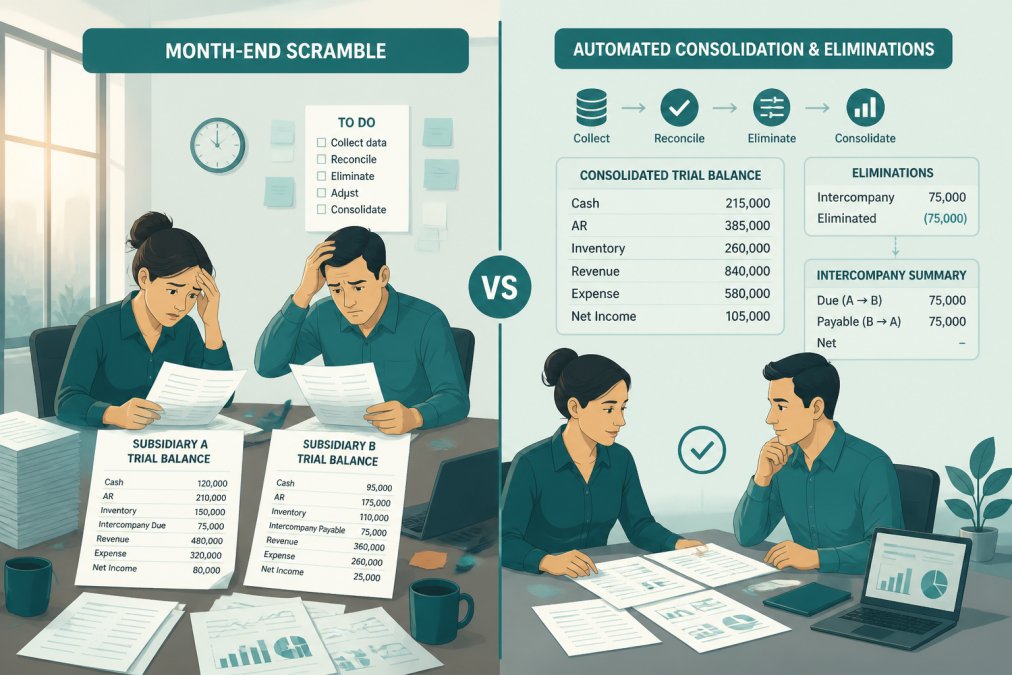
Intercompany Accounting and Eliminations Without the Month-End Scramble
Intercompany transactions are the biggest source of consolidation adjustments and month-end pain. When Entity A sells to Entity B, both sides must record the transaction identically, or the elimination won’t balance.
The Core Elimination Mechanics: A Worked Example
Consider a parent organization (Parent Co.) that owns 100% of Subsidiary A. Subsidiary A sells $50,000 of inventory to Parent Co. on credit, recording revenue and a receivable of $50,000; Parent Co. records inventory and a payable of $50,000.
The elimination journal entry at the parent level is straightforward:
- Debit Intercompany Revenue $50,000
- Credit Intercompany Receivable $50,000
- Debit Intercompany Payable $50,000
If the inventory remains on hand at period end, the profit element in the ending inventory must also be eliminated. Assuming a 20% gross margin, the unrealized profit is $10,000. The additional entry:
- Debit Cost of Goods Sold $10,000
- Credit Inventory $10,000
These entries are simple in isolation. Complexity arrives with dozens of intercompany pairs across entities, currencies, and transaction types, and when the two sides don’t match because of timing, FX rate differences, or data entry errors.
The Reconciliation Workflow That Prevents Month-End Fire Drills
Eliminations only work if both sides of every intercompany transaction are recorded identically and reconciled before the close deadline. A practical workflow:
- Standardize intercompany transaction types, define a fixed list (e.g., intercompany sales, intercompany loans, intercompany management fees) and require every entity to use the same codes.
- Require matched pairs at entry, each intercompany transaction must reference the counterparty entity and the corresponding transaction ID. This is a data field, not a memo line.
- Run an intercompany reconciliation report before the close cutoff, compare balances by counterparty pair. Any mismatch above a defined threshold (e.g., $100 or 0.1% of the balance) must be resolved before the entity’s books are locked.
- Post eliminations from a controlled template, generate elimination entries from reconciled intercompany balances, not manually each period. This is where ERP-native consolidation modules or dedicated tools earn their keep.
Teams that reconcile intercompany balances weekly, not just at month-end, can catch mismatches while transactions are still fresh.
Ownership Changes, Partial Ownership, and Minority Interests
Straightforward parent-subsidiary eliminations are the easy case. The harder scenarios involve partial ownership and changes in control.
- Partial ownership (minority interest): If Parent Co. owns 80% of Subsidiary B, the consolidated statements must reflect the 20% owned by outside shareholders. A common approach: consolidate 100% of Subsidiary B’s assets and liabilities, then present a separate line for noncontrolling interest in equity and in net income.
- Mid-year acquisitions: When an entity is acquired mid-year, only post-acquisition results are consolidated. The process must capture the acquisition date, fair value adjustments, and pre-acquisition equity elimination. A common error is consolidating the full year of the acquired entity’s results, overstating revenue and requiring a prior-period adjustment.
- Disposals and changes in control: When control is lost, the entity is deconsolidated. The parent recognizes any gain or loss on disposal, and the retained interest (if any) is remeasured at fair value. Include a deconsolidation checklist to avoid stale balances in the consolidated trial balance.
These scenarios can involve partial ownership and changes in control. Spreadsheets can be used to handle consolidation mechanics. Our guide to simplifying the financial close in NetSuite covers how ERP-native tools handle these mechanics.
Before your next close, pull the intercompany reconciliation report and count the unmatched pairs. If the number is higher than zero at the close deadline, your elimination process is reactive. The fix is a weekly reconciliation cadence and a hard cutoff for intercompany entries.
Multi-Entity Reporting Best Practices for Board-Ready Statements
Board-ready reporting means the numbers arrive on time, tie out, and come with a narrative the board can act on. Three practices get you there:
- Lock the reporting package format so each period is comparable to the last.
- Reconcile consolidated totals to the sum of entity-level reporting before anything ships.
- Separate actuals from adjustments so directors can see what changed and why.
Consolidated reporting should give stakeholders real-time visibility, not a month-old snapshot. If your board deck requires manual assembly every quarter, the reporting process is the problem. For a deeper walkthrough, see our NetSuite reporting guide for board meetings.
Choosing Financial Consolidation Software That Fits Your Entity Structure
Financial consolidation software earns its place when manual processes stop scaling, not before. The right system depends on entity structure, currency exposure, and how much of the close you want automated.
| Entity Structure | Typical Approach | What to Prioritize |
|---|---|---|
| Single currency, 2-3 entities | Spreadsheet with strict templates | Discipline and documented mapping |
| Multi-currency, 4-10 entities | ERP consolidation module | Currency translation and eliminations |
| Complex ownership, frequent M&A | Dedicated consolidation tool | Ownership hierarchies and audit trail |
| Multi-entity with lean finance team | Outsourced accounting plus ERP | Scalability without headcount |
A word of caution: buying software to fix a process problem rarely works. Map your consolidation workflow first, then let the tool fit it. Our team at Finlyte’s Partners, LLC helps CFOs evaluate whether their current ERP can carry the load or whether a dedicated tool makes sense.
Schedule Your Free Assessment →
Governance, Controls, and Audit Evidence Across the Parent Organization
Auditors don’t just want consolidated financial statements, they want to see how you got there. Every consolidation adjustment needs a journal entry, an approver, and a supporting schedule. Governance is the difference between a process that survives an audit and one that generates a findings letter.
The Approval Matrix: Who Signs Off on What
A consolidation close touches multiple entities and review layers. Without a defined approval matrix, sign-offs happen informally, and informal sign-offs are invisible to auditors. A practical matrix:
| Control Point | Owner | Approver | Evidence Required |
|---|---|---|---|
| Entity trial balance close | Subsidiary controller | Parent controller | Signed close checklist, trial balance |
| Chart of accounts mapping changes | Consolidation accountant | Parent controller | Mapping change log with rationale |
| Intercompany reconciliation | Consolidation accountant | Parent controller | Reconciliation report with matched/unmatched pairs |
| Elimination journal entries | Consolidation accountant | Parent controller or CFO | Journal entry with supporting calculation |
| Foreign currency translation | Consolidation accountant | Parent controller | Rate source documentation, translation schedule |
| Final consolidated statements | Parent controller | CFO | Consolidated trial balance, review sign-off |
This matrix is not bureaucracy. It’s the evidence trail an auditor will request. If the approval for an elimination entry lives in an email thread, the control is effectively undocumented.
Audit Trail Components: What Auditors Actually Request
A consolidation audit trail has four components, each retrievable on demand rather than reconstructed after the fact:
- Entity-level trial balances, the starting point for every consolidation. Auditors will tie the consolidated numbers back to these. If a subsidiary’s trial balance changes after submission, the change must be logged and approved.
- Mapping documentation, a current mapping table tying every subsidiary account to a parent account, with a change log showing who changed what and why. Mapping changes are a common source of consolidation errors, and auditors know it.
- Elimination workpapers, for each elimination entry, the supporting calculation: intercompany balances, reconciliation status, FX rates applied, and approver. A journal entry without a workpaper is an audit finding waiting to happen.
- Consolidation review sign-off, evidence that a qualified reviewer examined the consolidated statements against entity-level data and elimination workpapers before finalization. This control catches errors before they reach the board.
Teams can maintain these four components in a shared, access-controlled repository.
Access Controls and Segregation of Duties
Consolidation is a high-risk area for segregation-of-duties conflicts: whoever prepares an elimination entry should not approve it, and whoever maintains the chart of accounts mapping should not post the consolidation adjustments.
In an ERP environment, role-based access enforces these controls: the consolidation accountant has prepare but not post rights; the parent controller has review and post rights but not mapping-change rights.
Documenting Consolidation Judgments
Some consolidation decisions require judgment: a foreign subsidiary’s functional currency, the fair value of an acquired entity’s assets, the classification of a partially owned entity. Document these contemporaneously, not after the auditor asks.
A practical standard: for each judgment, document the facts, alternatives considered, conclusion, and approver. A one-page memo per material item suffices, the goal is to show the judgment was made deliberately and reviewed by someone with authority.
An audit trail that lives in someone’s inbox is not an audit trail. If your consolidation evidence is scattered across email threads, shared drives, and individual laptops, you have a control gap, regardless of how accurate the final numbers are.
For teams weighing native ERP controls against external support, this comparison of NetSuite audit and compliance options clarifies the trade-offs. The answer depends on entity count, audit requirements, and how much of the control environment you enforce through configuration versus procedure.
A Decision Framework for Your Multi-Entity Financial Consolidation Strategy
Use this framework to choose your approach. Answer each question honestly, then follow the branch.
- Do subsidiary books close within five business days of period end? If no, fix the entity-level close before touching consolidation.
- Are intercompany balances reconciled before the deadline? If no, standardization and matching rules come first.
- Does the parent organization hold multiple currencies? If yes, currency translation and exchange rate policy must be documented.
The pattern behind the framework: fix process, then data, then tooling.
Scheduling Your Free Consolidation Assessment
Consolidation problems can show up as a delayed close, a board deck needing revisions, or a controller who dreads the last week of every month.
If that sounds familiar, start with a structured assessment rather than another spreadsheet workaround. Contact Finlyte’s Partners, LLC to schedule a free assessment. As an Oracle NetSuite Partner of the Year with certified consultants who combine ERP technical depth with financial services experience, we offer tailored solutions for NetSuite and QuickBooks users.
Get started with Finlyte’s Partners, LLC.
Frequently Asked Questions
What is multi-entity financial consolidation?
Multi-entity financial consolidation is the process of combining the general ledger activity of a parent organization and its subsidiaries into one set of consolidated financial statements. It requires standardizing each entity’s chart of accounts, translating foreign currency balances, eliminating intercompany transactions, and posting consolidation adjustments. The output is a single balance sheet, income statement, and cash flow statement that reflects the group’s financial health rather than any one legal entity’s position.
How does the financial consolidation process work across multiple legal entities?
The financial consolidation process runs in a fixed sequence. Each subsidiary closes its own books and submits a trial balance. The parent maps every account to a group chart of accounts, translates foreign currency balances at the correct exchange rates, and records intercompany eliminations so balances between entities net to zero. Consolidation adjustments follow, then the group statements are produced. Teams can automate the mapping and elimination steps.
How do you handle intercompany accounting and eliminations during consolidation?
Intercompany accounting and eliminations require that every transaction between entities be recorded on both sides with a matching reference. At consolidation, reciprocal balances, intercompany revenue and expense, and unrealized profit in inventory must be removed so the group statements do not double count. The practical fix is a defined elimination workflow: agree balances before close, log each elimination as a journal entry with supporting detail, and review any unmatched items before the group trial balance is finalized.
What are multi-entity reporting best practices for a faster close?
Multi-entity reporting best practices can include standardizing routine processes. Standardize the chart of accounts across entities, lock a close calendar with entity-level deadlines, require subsidiary sign-off before submission, and automate currency translation and eliminations. Keep a consolidation checklist that names every adjustment and its owner. Teams can document these steps and repeat them every period.
How does NetSuite support multi-entity consolidation?
NetSuite is a software system that finance teams may evaluate for multi-entity consolidation.
What should finance teams look for in financial consolidation software?
Financial consolidation software should cover four things: multi-currency translation with rate management, account mapping from entity to group charts of accounts, a controlled elimination workflow with supporting detail, and an audit trail on every adjustment. Beyond features, check how the system handles complex ownership structures such as partial ownership and mid-year acquisitions. Also confirm the reporting layer produces board-ready statements without a manual export step, because that export is where errors usually enter.

